The Missing Piece of Energy Production Most People Ignore
Introduction
Most conversations about energy focus on what the body takes in. People talk about oxygen, nutrition, hydration, and supplements like creatine. Those things matter, but they are only part of the equation.
There is another side to energy production that gets far less attention. Your body also needs to clear waste efficiently. If waste products build up inside tissues and around cells, the entire system starts to slow down.
This affects the brain, the muscles, circulation, and even the mitochondria that produce cellular energy.
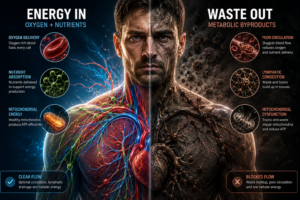
The body is not just a system of fuel delivery. It is also a system of flow, movement, and clearance.
Energy Production Depends on Clearance
Every time your cells produce energy, waste byproducts are created. Normally, the body removes those byproducts through circulation, venous return, and the lymphatic system.
But when that process slows down, congestion starts to build.
This can affect how efficiently oxygen and nutrients move through tissues. It can also reduce how well mitochondria produce ATP, the energy currency used by the body.
That means even if someone is taking creatine or improving nutrient intake, they still may not feel the full effect if waste is not being cleared properly.
This is why recovery and clearance are essential parts of performance.
The Brain Has Its Own Waste Removal System
One of the clearest examples of this process is found in the brain.
The brain has a specialized waste clearance network called the glymphatic system. This system moves fluid through brain tissue and helps remove metabolic waste that accumulates throughout the day.
When this process slows down, people often experience symptoms like brain fog, fatigue, poor concentration, and low mental energy.
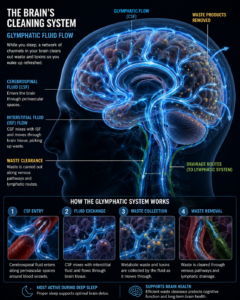
What makes this system especially interesting is that it does not have a pump like the heart. Instead, it depends heavily on movement, pressure changes, and breathing patterns.
Research now shows that deep breathing can significantly increase fluid movement in the brain. In simple terms, the way you breathe directly affects how efficiently your brain clears waste.
The Lymphatic System Works the Same Way
The same principle extends beyond the brain into the rest of the body.
The lymphatic system helps remove waste, excess fluid, and cellular debris from tissues. Unlike the circulatory system, it also lacks a central pump.
Instead, lymphatic flow depends on body movement and internal pressure shifts.
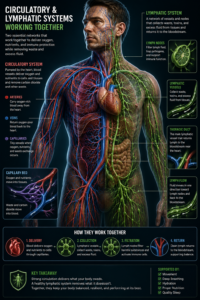
One of the most important drivers of this process is the diaphragm.
When you breathe deeply, the diaphragm moves downward and changes pressure inside the thoracic cavity and abdomen. This creates a natural pumping effect throughout the body.
That pressure movement helps circulate blood, move lymphatic fluid, and support nutrient exchange at the tissue level.
Breathing is not just about oxygen. It is also a mechanical process that drives circulation and waste clearance.
Why CO2 Changes the Equation
Most people think of carbon dioxide as something the body simply gets rid of. In reality, CO2 plays a major role in regulating breathing and circulation.
Elevated CO2 naturally stimulates deeper breathing. As breathing depth increases, the diaphragm becomes more active, pressure changes become stronger, and internal circulation improves.
This creates a more powerful pumping effect through the venous and lymphatic systems.
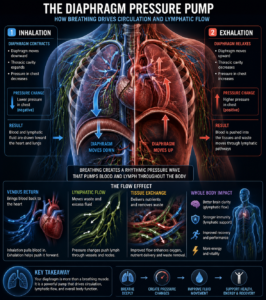
As this happens, blood is pushed toward tissues during exhalation and pulled back toward the heart and lungs during inhalation. At the same time, waste products move more efficiently through venous and lymphatic pathways.
This helps the body maintain better flow and recovery.
What Happens Inside the Cell
All of this ultimately affects mitochondrial function.
Mitochondria rely on efficient delivery and efficient clearance at the same time. If waste products accumulate around cells, energy production becomes less efficient.
Over time, mitochondrial output slows down and ATP production drops.
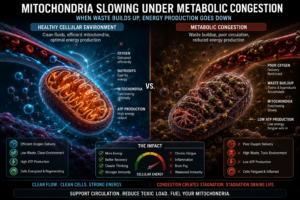
This is why fatigue is not always caused by lack of fuel. Sometimes the problem is congestion within the system itself.
The body cannot perform efficiently if waste removal is impaired.
The Bigger Picture
Energy production is not a single process. It is a coordinated system built on three connected layers:
- Delivery
- Cellular energy production
- Recovery and waste clearance
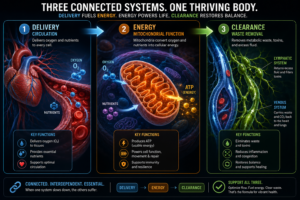
When all three work together, the body functions more efficiently. Circulation improves. Recovery improves. Mental clarity improves. Cellular energy production becomes more stable.
Sometimes the missing piece is not more stimulation or more supplementation.
Sometimes it is restoring movement, flow, and clearance throughout the system.
Learn more at THECARBONATEDBODY.COM