Breathing May Be One of the Body’s Hidden Circulatory Systems
Most people think breathing only exists to bring oxygen into the body. But breathing also creates mechanical pressure changes that help move blood, lymphatic fluid, and other vital fluids throughout the body.
This idea is explored in Chapter 11 of The Carbonated Body, where breathing is described as more than a respiratory process. The diaphragm acts like a secondary circulatory pump that assists movement through systems the heart cannot fully manage alone.
The result is a completely different way to understand breath, circulation, recovery, and internal flow.
The Diaphragm Works Like a Pressure Pump
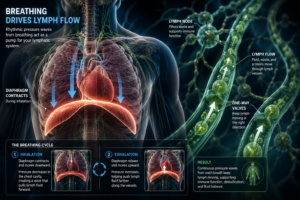
Every inhale changes pressure inside the chest cavity. As the diaphragm contracts and moves downward, blood is pulled upward through the veins toward the heart. During exhalation, pressure shifts again and helps push fluid through the lymphatic system.
This creates rhythmic pressure waves through the torso that assist circulation continuously throughout the day.
Unlike arteries, many veins and lymphatic vessels rely heavily on movement and pressure changes to move fluid efficiently. Breathing helps provide that movement internally.
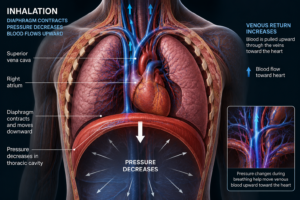
These pressure changes may also influence cerebrospinal fluid movement around the brain and spinal cord, helping circulation reach areas where passive flow is slower.
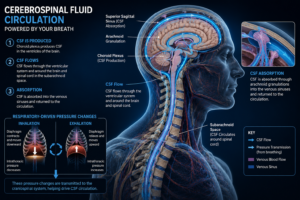
Why Slow Controlled Breathing Changes the Body
Slow breathing has already been associated with improved heart rate variability, reduced stress signaling, and stronger parasympathetic activity. In simple terms, the body shifts into a more restorative state.
But the effects may go beyond relaxation.
As breathing becomes slower and deeper, the diaphragm becomes more active. This increases the strength of the internal pressure waves moving through the torso.
That can improve:
- Venous return to the heart
- Lymphatic circulation
- Oxygen delivery to tissues
- Internal fluid movement
Breathing becomes more than air exchange. It becomes part of the body’s transport system.
The Role of Carbon Dioxide in Circulation
Carbon dioxide is usually viewed as a waste gas, but the body uses CO2 as an important regulator of circulation and oxygen delivery.
When CO2 levels rise in a controlled way, blood vessels can relax and widen. This helps improve blood flow and allows oxygen to release more efficiently into tissues.
At the same time, breathing mechanics often become stronger and more coordinated. The diaphragm works harder, pressure gradients increase, and circulation improves throughout the body.
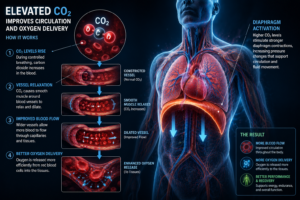
This is one reason breathing practices are increasingly being studied in relation to recovery, performance, and nervous system regulation.
Breathing as an Internal Engine
Most people think of exercise as something that only happens through muscular movement. But breathing itself may act like a form of internal exercise by continuously assisting circulation and fluid movement from the inside out.
The body depends on flow for oxygen delivery, nutrient transport, waste removal, and recovery. Breathing helps support all of these processes through mechanical pressure and rhythm.
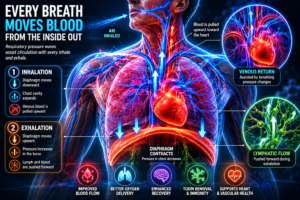
Understanding this changes the way we think about the respiratory system. Breath is not isolated from circulation. The two systems work together constantly.
When breathing improves, circulation may improve with it.
Conclusion
Breathing is far more than oxygen entering the lungs. Every breath creates pressure changes that influence circulation throughout the body.
The diaphragm may function like a secondary pump that helps move blood, lymphatic fluid, and other vital fluids through systems the heart alone cannot fully support.
This perspective opens a new way of understanding recovery, energy, circulation, and human physiology from the inside out.
Learn more at THECARBONATEDBODY.COM