The Vascular Battery: Is Circulation About More Than the Heart?
Introduction
Most of us were taught that circulation is simple. The heart pumps blood, pressure pushes it through vessels, and oxygen and nutrients are delivered to tissues.
While that model is true, it may not tell the whole story.
When scientists look at blood flow inside the smallest vessels of the body, they find behavior that cannot always be explained by pressure alone. At the microscopic level, blood moves through an environment that is highly organized, highly structured, and potentially influenced by electrical forces.
This raises an interesting question: What if circulation is not only mechanical, but also electrochemical?
The Hidden Structure Inside Blood Vessels
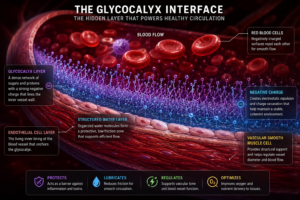
Every blood vessel is lined by a delicate layer called the glycocalyx. This structure forms the boundary between flowing blood and the vessel wall.
What makes the glycocalyx unique is that it carries a strong negative electrical charge. When water comes into contact with this charged surface, it becomes more organized. Instead of behaving like ordinary liquid water, it forms structured layers that create a smoother and more stable environment for blood flow.
This organized layer helps reduce friction and supports efficient movement through the microcirculation.
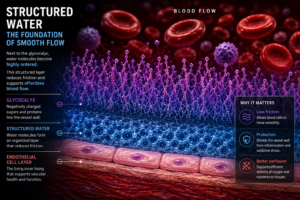
Red blood cells also carry negative charge. This helps them remain separated from one another and move smoothly through narrow capillaries.
In this view, circulation is not simply blood moving through pipes. It is blood moving through a carefully organized environment.
Where Carbon Dioxide Fits Into the Picture
Carbon dioxide is often thought of as a waste product that must be removed from the body.
However, carbon dioxide may play a much larger role.
When carbon dioxide dissolves in water, it contributes to reactions that generate hydrogen ions and bicarbonate. These reactions occur continuously throughout the bloodstream and along vessel walls.
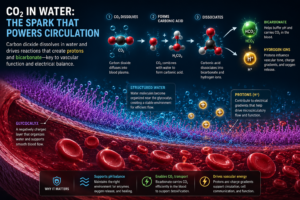
As structured water forms near the glycocalyx, charge separation begins to occur. Negative charge remains near the vessel wall while positively charged particles move farther away.
This creates an electrical gradient inside the vascular system.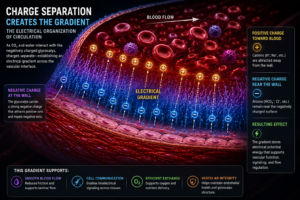
Rather than viewing circulation purely as pressure-driven flow, this perspective suggests that blood vessels may also maintain organized electrical conditions that support efficient movement and communication throughout the body.
The Idea of a Vascular Battery
Once electrical gradients exist, blood flow may generate additional electrical activity.
Researchers have described a phenomenon known as streaming potential, where fluid moving across a charged surface naturally produces small voltage differences.
Inside the capillary network, this means that blood flow itself may contribute to ongoing electrical organization.
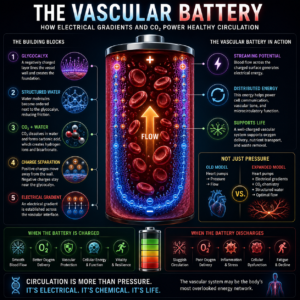
The result is a fascinating possibility. The vascular system may function not only as a transportation network but also as a distributed energy system extending throughout the body.
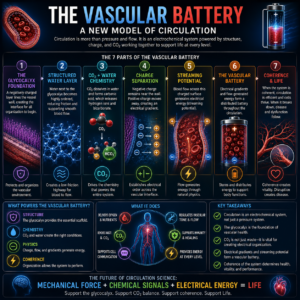
This does not replace the role of the heart. Instead, it suggests that circulation may depend on both mechanical force and electrical organization working together.
Conclusion
Health is often viewed through the lens of blood pressure, heart function, and circulation volume. These factors are important, but they may only be part of the picture.
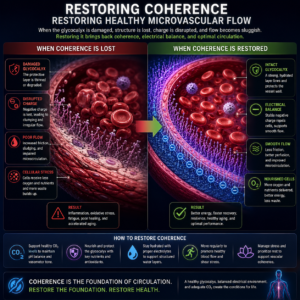
The glycocalyx, structured water, charge separation, and carbon dioxide all appear to contribute to the organization of blood flow at the microscopic level.
When this organization is maintained, circulation may become more efficient. When it breaks down, tissues may receive less effective delivery of oxygen and nutrients despite the heart continuing to work hard.
The emerging concept of a “vascular battery” offers a new way to think about circulation, not simply as movement, but as an organized biological system that depends on structure, coherence, and energy.
Learn more at THECARBONATEDBODY.COM