Maybe you were never low on energy. Maybe your engines were never the problem.
You wake up already tired. Not the kind of tired a good night's sleep fixes. The kind that is still there after eight hours of sleep, still there after the coffee, still there after the days you did everything right. So you go looking for more energy. A cleaner diet. A better supplement. Anything to switch your engines back on. Maybe something helps for a week, and then the flatness settles back in.
Here is a question worth sitting with. If chronic fatigue were simply an empty battery, why does it come on so slowly, and why does almost everything you throw at it barely move the needle? An empty battery drains in a day. What you are feeling took years. That slow arrival is a clue, and it points somewhere most fatigue advice never looks.
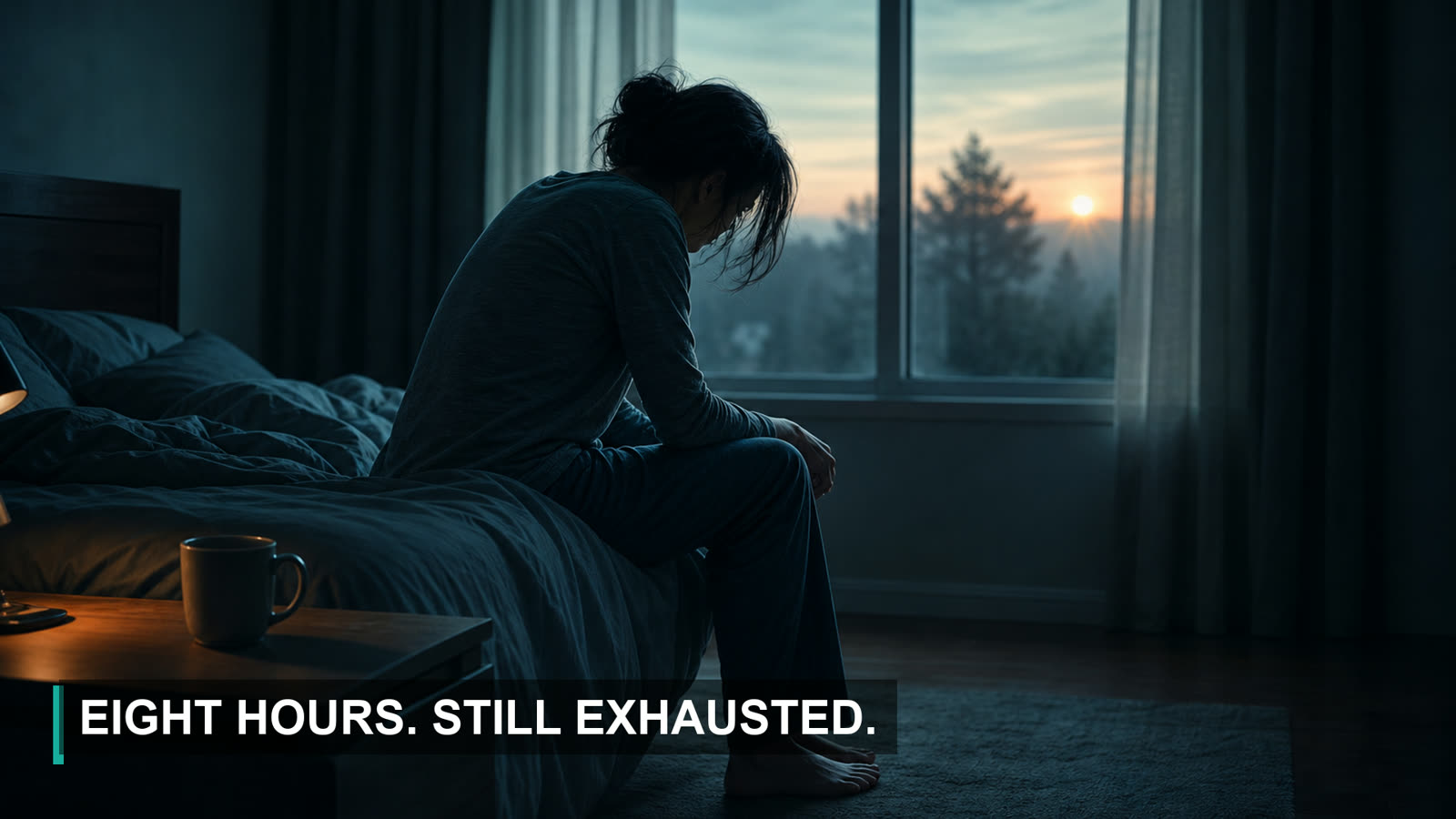
Before we go further: lasting exhaustion deserves to be taken seriously. It can come from thyroid disease, anemia, sleep disorders, autoimmune conditions, infections, medications, or depression. If you have not been properly worked up, that comes first. Get the labs. Rule things out. But there is a specific person this is written for. The one who has been checked, whose blood work comes back normal, who is told they are basically fine, and who still knows something is wrong.
The assumption hiding inside almost every answer
For that person, nearly every piece of advice points in the same direction. It assumes you are low on energy and that the fix is to make more of it. Boost the mitochondria. Push the engines harder. More fuel, more output, more energy. But what if you were never low on energy at all? What if the real problem is that you are making it dirty?
This is a different way to look at exhaustion, so stay with it. Your cells make energy by burning oxygen. That part is true. But oxygen is not gentle. It is a spark: reactive, hungry, a little wild. When you burn a spark like that without something to temper it, you do not just get energy. You get sparks flying off in every direction.
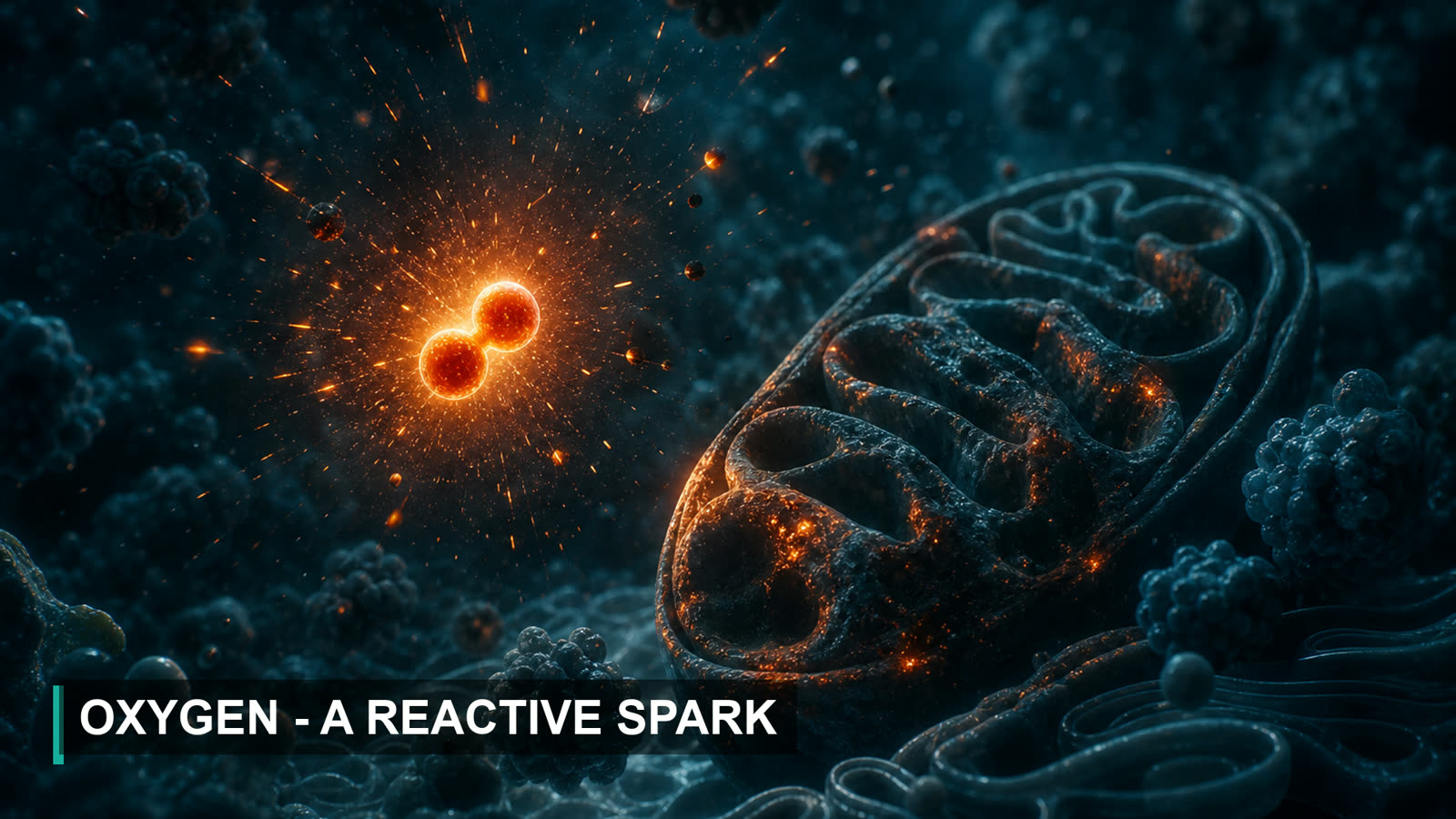
Scientists have names for those stray sparks: free radicals, oxidative stress. Tiny bursts of damage that scorch the very machinery producing your energy, the mitochondria, the membranes, the proteins, even the DNA inside the cell. Notice the shift. Having oxygen in the blood is not the same as burning it cleanly. Making energy is not the same as making it without a cost. Supply is not the same as safe, usable delivery.
Two fires, same fuel
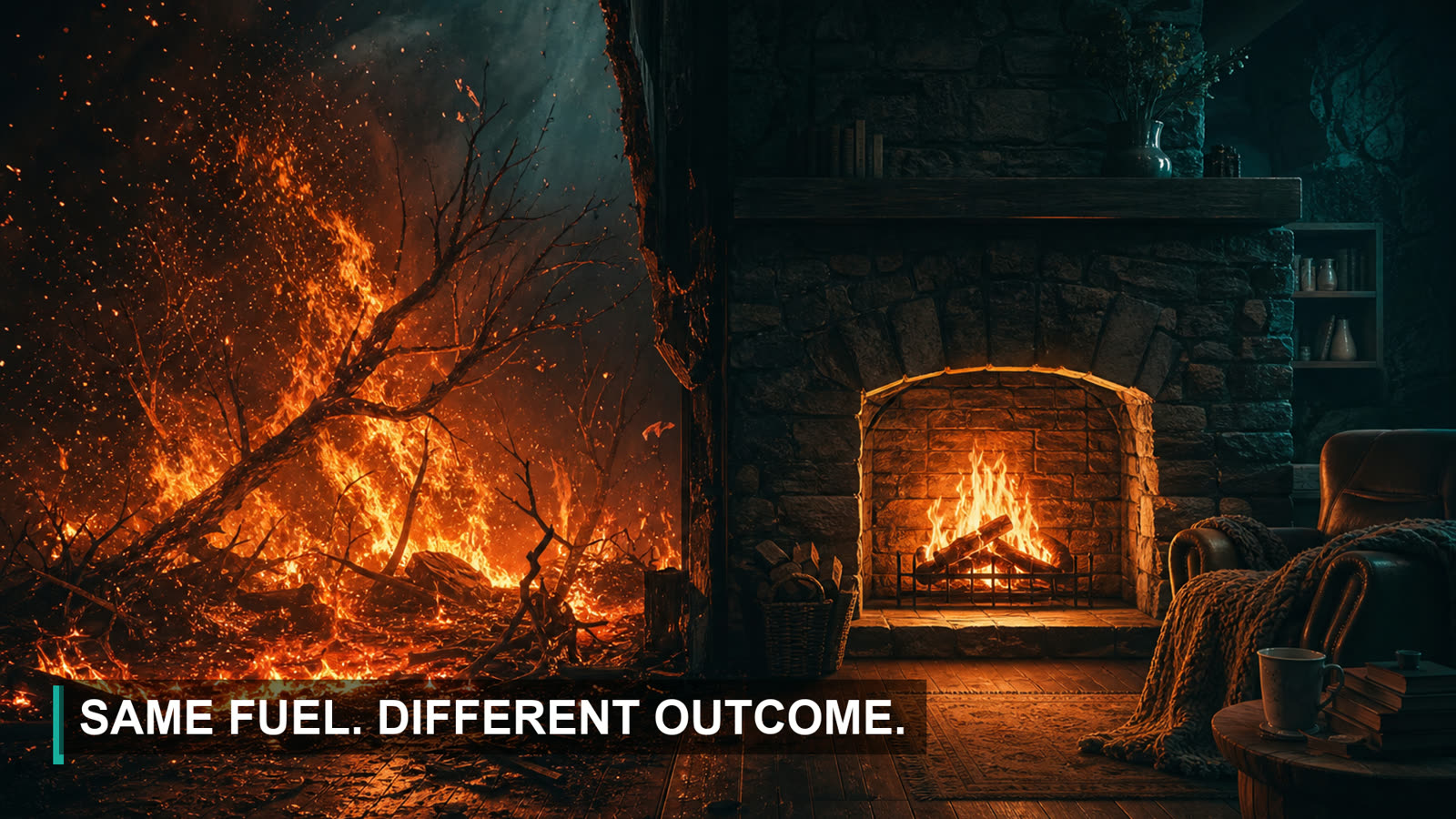
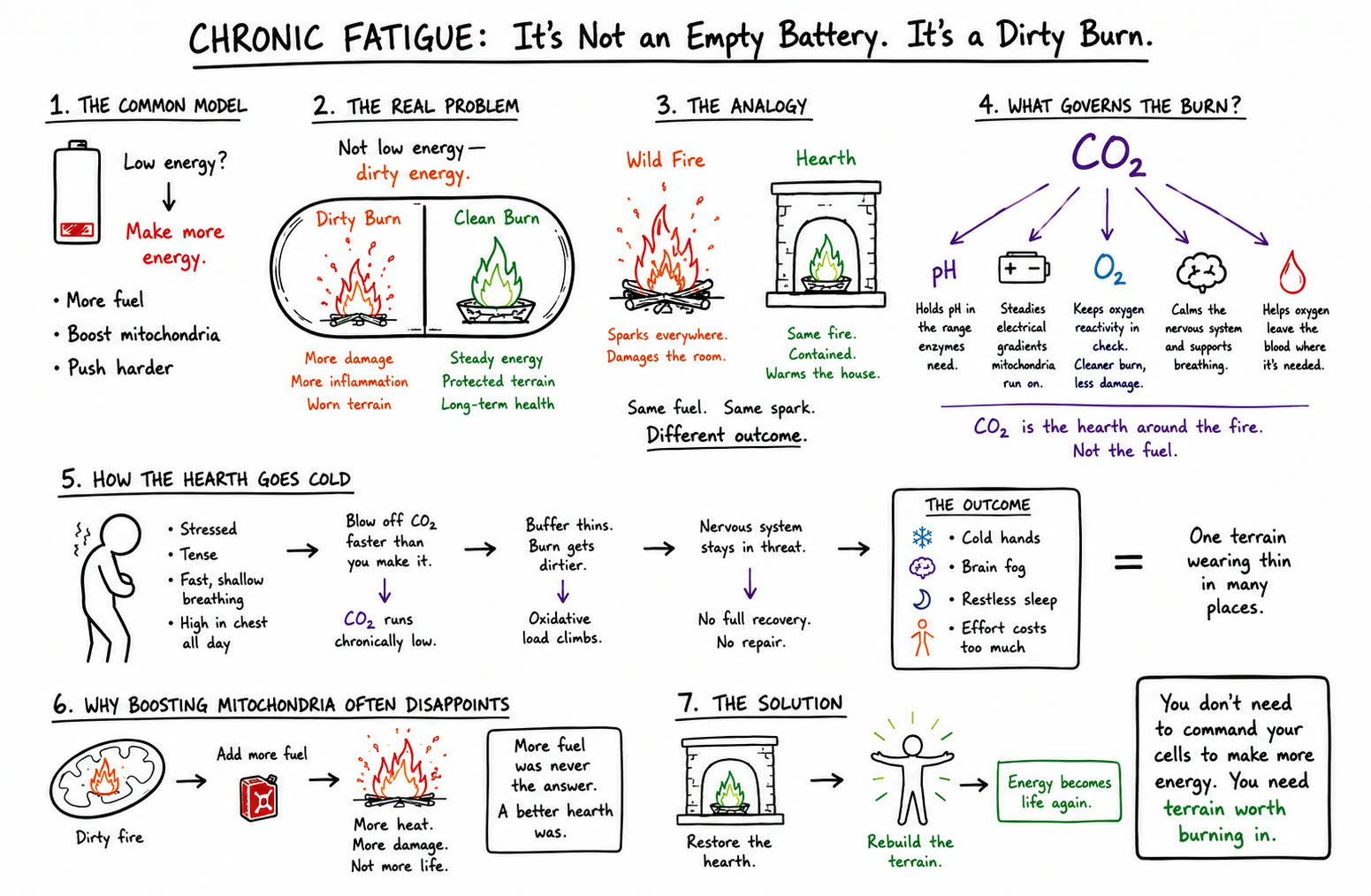
Picture two fires. One is a wildfire, throwing flames onto everything around it. The other is that same fire held inside a hearth: contained, steady, warming the room instead of burning it down. Same fuel. Same spark. Completely different outcome. The difference is not how much you burn. It is how well the burn is governed.
This is what almost no fatigue video will tell you. When the burn goes dirty, your body does not necessarily make less energy at first. It makes energy at a cost. Every bit of fuel comes with a little more damage, a little more inflammation, a little more wear. And over the years, the terrain your cells live in slowly degrades.
The word that changes everything: terrain
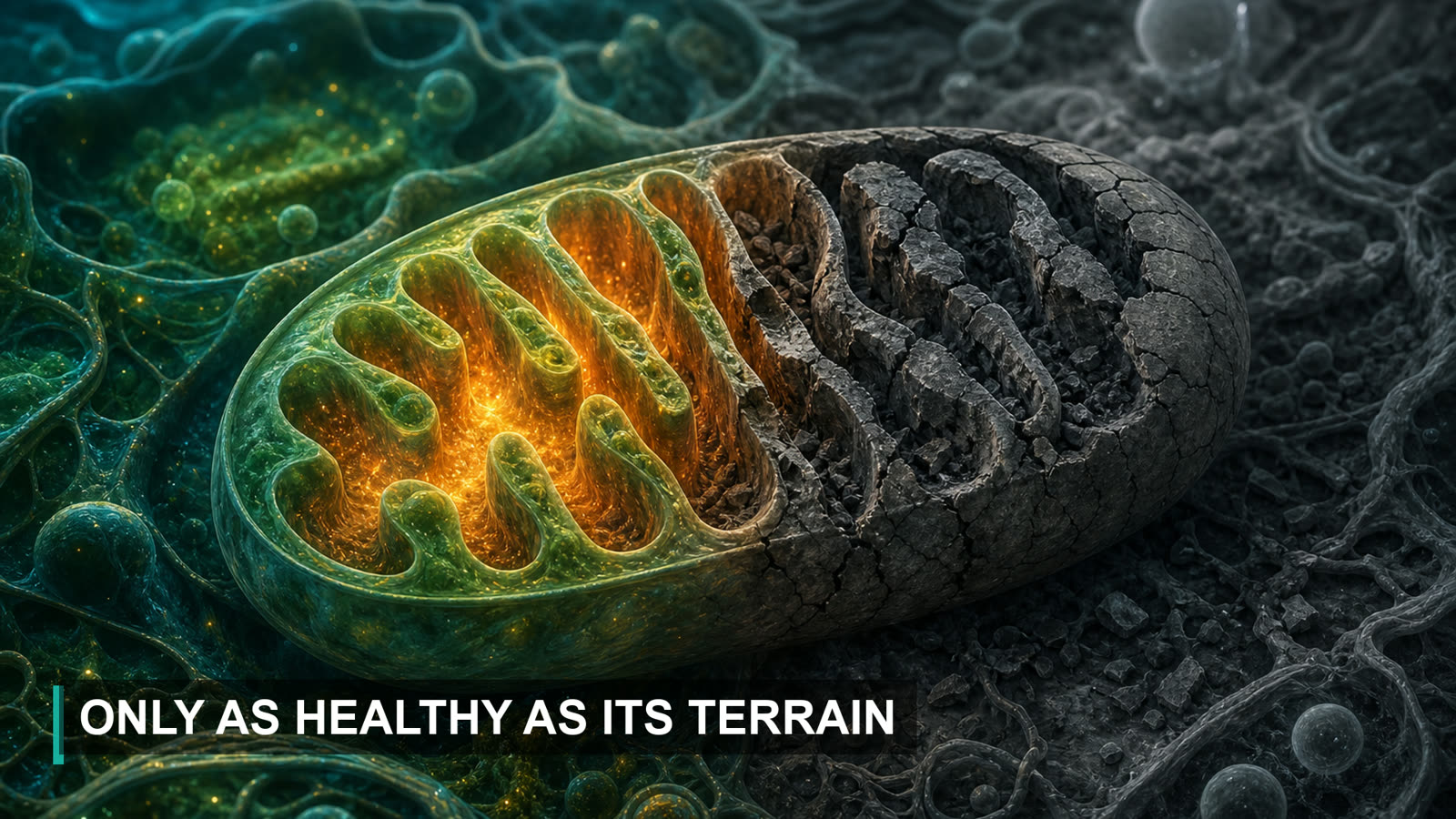
Your body is not a machine made of parts you swap out. It is a living environment. Your mitochondria are only ever as healthy as the terrain surrounding them: the chemistry, the acidity, the electrical balance, the fluid conditions your cells are trying to work inside. You can give better fuel to a cell all day long. If it is burning in a bad terrain, you are just giving it more to burn dirty.
So the real question is not how much energy you make. It is what governs the burn. What turns a wild spark into a contained hearth? And here is where we finally meet the molecule we were all taught to throw away: carbon dioxide.
Carbon dioxide is the hearth, not the fuel
We are taught that CO2 is nothing but a waste gas, the exhaust we breathe out. But inside the body, carbon dioxide is one of the great stabilizers of terrain. It is not the fuel. It is the earth around the fire. Carbon dioxide helps hold your pH in the narrow range your enzymes need. It steadies the electrical gradients your mitochondria actually run on. It keeps oxygen reactivity in check, so the burn stays controlled instead of spinning off damage everywhere. It helps calm the nervous system that governs how you breathe in the first place. And yes, through the Bohr effect, it helps oxygen leave the blood and reach the tissue where it is needed. But that is just one job among many.
Oxygen is the spark. Carbon dioxide is the hearth. One ignites the energy. The other shapes the conditions that let that energy warm the house instead of burning it down. Remove the hearth, and even a well fueled fire becomes something that slowly destroys the room it was meant to heat.
How the hearth goes cold
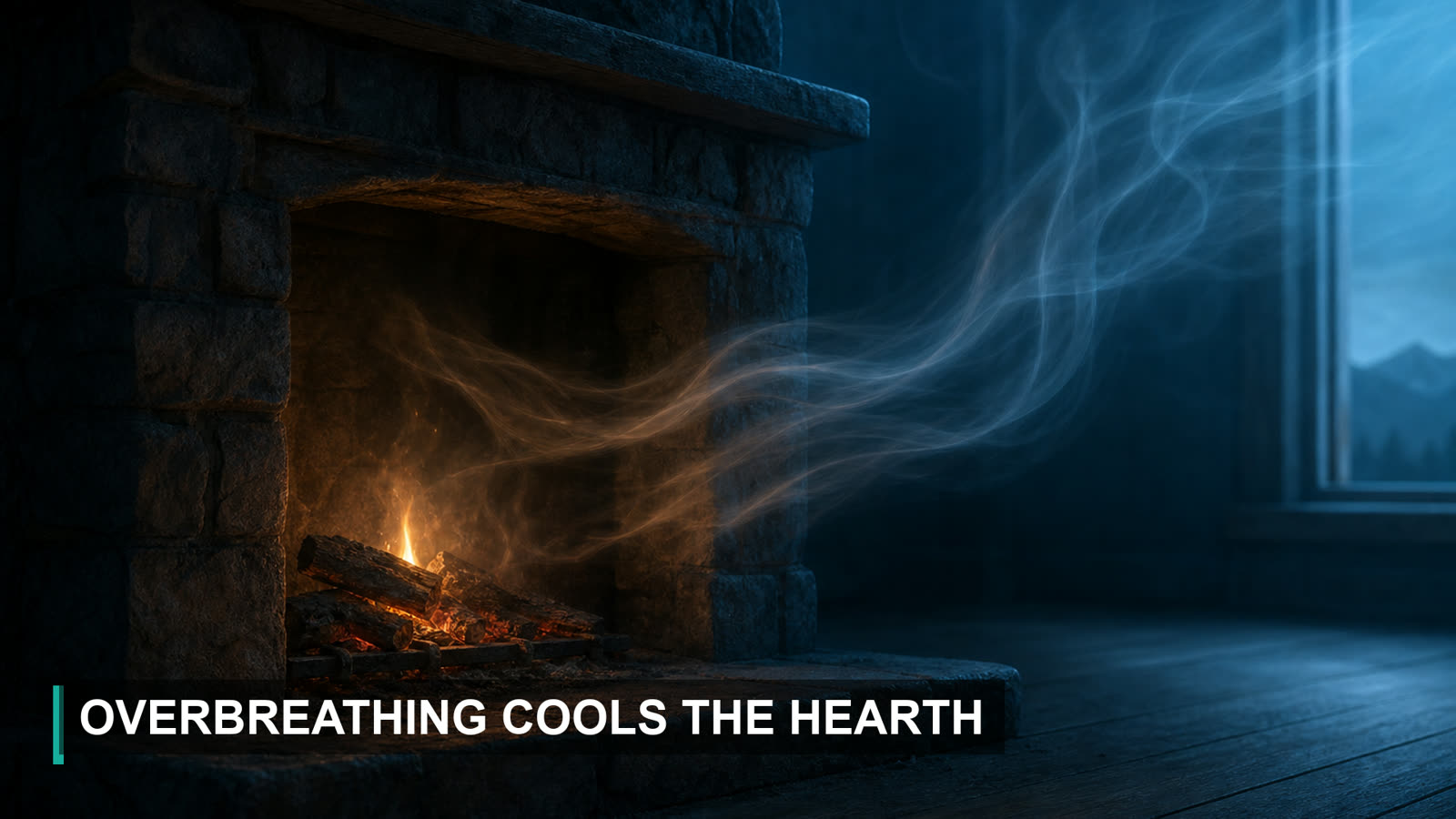
Now watch how the hearth goes cold, quietly, over years. When you live braced and tense, breathing fast and shallow and high in the chest the way a depleted body breathes all day long, you blow off carbon dioxide faster than you can make it. The buffer thins. The burn gets a little dirtier. The oxidative load climbs. And your nervous system stays locked in a low state of threat that keeps you out of repair.
Sit with what that means. Your fatigue may not be a shortage of energy at all. It may be years of burning energy in an unprotected terrain, in a body too braced to ever fully recover between the burns. That is why it arrives slowly. Terrain does not collapse overnight. It erodes. Cold hands. Restless sleep. A brain that fogs by mid afternoon. Effort that costs far more than it should. These are not four separate glitches. They are one terrain wearing thin in different places.
Why boosting the mitochondria so often disappoints
This is also why boosting your mitochondria so often disappoints, or even backfires. Push a dirty fire harder and you do not get vitality. You get more heat, more damage, more embers on the floor. More fuel was never the answer. A better hearth was. Dysfunction is rarely the beginning of the story. It is the consequence of conditions that failed long before.
None of this makes carbon dioxide a treatment. It is not a cure for chronic fatigue, and it does not compete with medicine, sleep, nutrition, breathwork, or exercise. It is one of the quiet coordinators that decides whether the good things you already do can actually reach the cell and burn clean once they get there.
Rebuilding the terrain
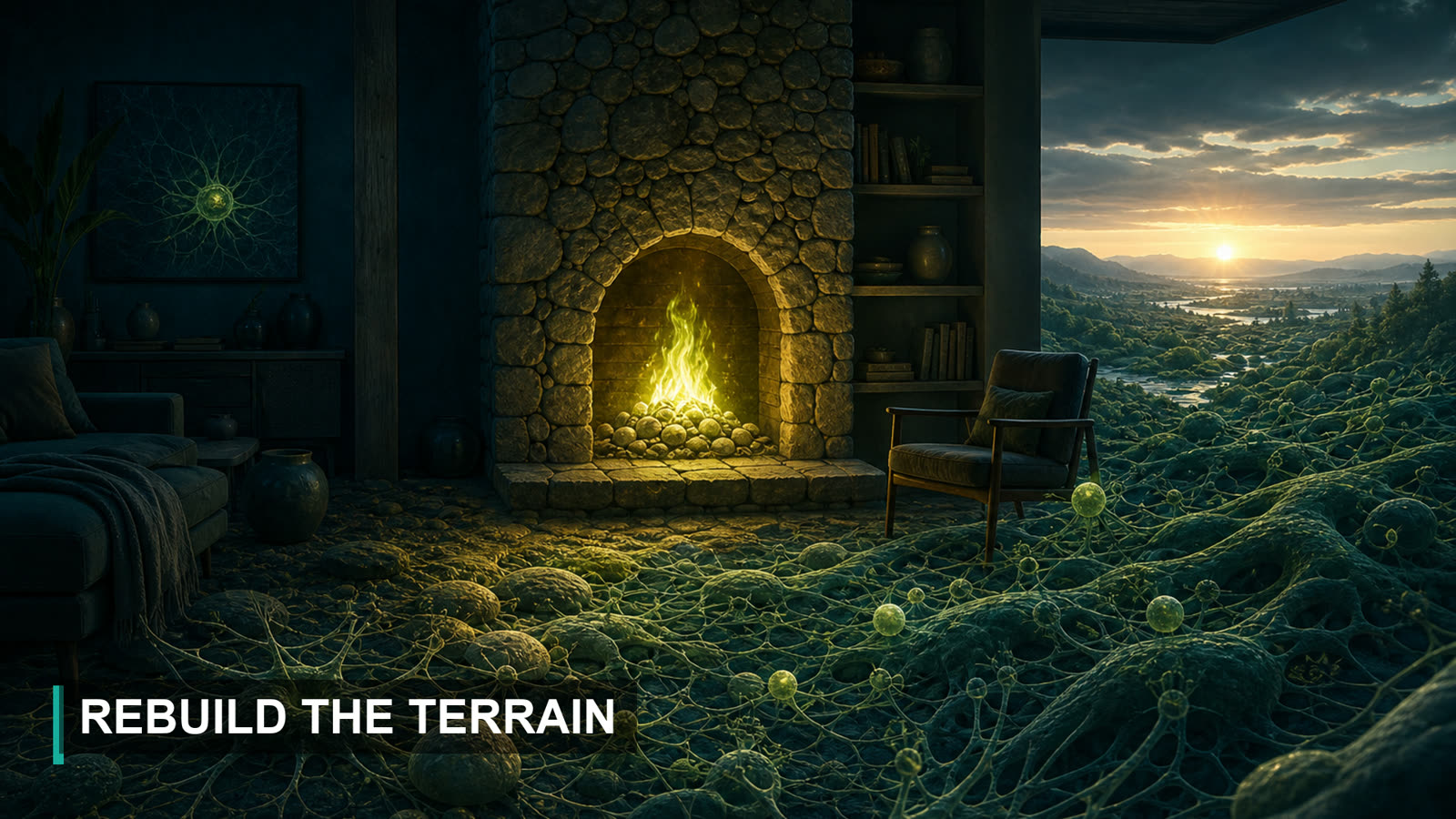
So where does that leave you? Maybe you were never low on energy. Maybe your engines were never the problem. Maybe exhaustion is what it feels like to make energy, year after year, in a terrain that can no longer protect you from your own fire. And here is the part that matters: terrain can be rebuilt. The hearth can be restored. The body is not waiting to be forced back to life with a stronger switch. It is waiting for the conditions in which fire burns clean again.
You do not need to command your cells to make more energy. You need to give them a terrain worth burning in. Because health was never just the presence of energy. It is the return of the conditions that let energy become life instead of damage.
Go deeper in The Carbonated Body and at CO2VIDEOS.com.