Why Creatine Might Not Be Working
Introduction
Creatine is one of the most researched supplements in the world. It is widely used to support strength, energy production, muscle recovery, and athletic performance. For many people, it works extremely well. But others take it consistently and feel little to no noticeable effect.
Most people assume the solution is simple: take more creatine.
That is why higher doses, loading phases, and even extreme daily intakes have become increasingly popular. But dosage may not be the real issue. In many cases, the problem is not how much creatine enters the body. The problem is whether the body can actually deliver it to muscle cells.
This changes the conversation entirely.
Creatine Must Be Delivered, Not Just Absorbed
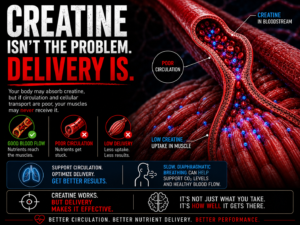
Most discussions around creatine focus on absorption, but absorption is only the beginning of the process.
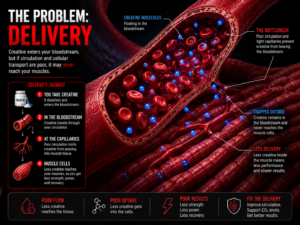
After creatine enters the bloodstream, it still has to move through circulation, pass through tiny capillary networks, and eventually enter muscle tissue where it can support energy production.
That process depends heavily on healthy blood flow and efficient nutrient delivery.
If circulation is functioning properly, nutrients move smoothly through the vascular system and reach cells efficiently. Oxygen delivery improves, waste products are removed more effectively, and muscle tissue receives the compounds it needs to perform and recover.
But when circulation becomes restricted, delivery slows down.
Creatine can exist in the bloodstream without ever reaching muscle cells in meaningful amounts. This may explain why some people continue increasing dosage while still experiencing poor results.
Why More Creatine Does Not Always Work
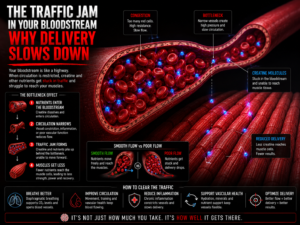
A helpful way to understand this is to think of the bloodstream like a highway system.
Your blood vessels are the roads. Muscle cells are the destination.
If traffic is flowing smoothly, nutrients reach their targets efficiently. But if circulation becomes restricted, adding more nutrients into the bloodstream may only create a larger bottleneck.
This is one reason many people feel creatine becomes less effective with age, chronic stress, fatigue, or declining metabolic health.
The issue may not be insufficient intake. It may be reduced delivery capacity.
Poor circulation can contribute to:
- Slower nutrient transport
- Reduced oxygen delivery
- Lower cellular energy production
- Decreased muscular performance
- Poor recovery
Instead of fixing the delivery system, many people simply increase supplementation and hope for better results.
The Importance of Microcirculation
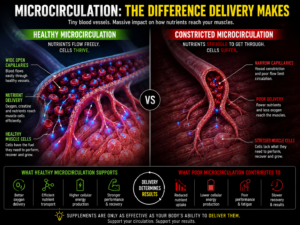
Microcirculation refers to the smallest blood vessels in the body, including capillaries that directly supply tissues with oxygen and nutrients.
These tiny vessels play a major role in whether nutrients can actually reach muscle cells.
When capillary networks become restricted or less efficient, blood flow slows and nutrient exchange becomes more difficult. Even if nutrients are available in the bloodstream, cells may struggle to receive them efficiently.
This is especially important for performance because muscle tissue has high energy demands and relies heavily on proper circulation.
The Role of CO2 and Blood Flow
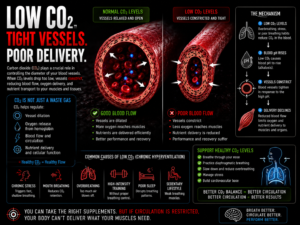
One of the most overlooked factors affecting circulation is carbon dioxide, or CO2.
Most people think of CO2 only as a waste gas produced during breathing. In reality, CO2 plays a major role in helping regulate blood vessel tone and circulation.
Healthy CO2 levels help blood vessels remain more relaxed and open. But when CO2 levels drop too low, blood vessels can constrict, increasing vascular resistance and reducing nutrient delivery throughout the body.
This affects:
- Oxygen transport
- Blood flow
- Nutrient movement
- Cellular energy production
Low CO2 states are often linked to chronic stress, poor breathing habits, and overbreathing patterns.
Why Breathing Matters
One of the simplest ways to begin improving circulation is through diaphragmatic breathing.
Slow nasal breathing and proper diaphragm engagement may help support healthier CO2 balance and improve blood vessel function. Better circulation can help nutrients move more effectively through the body and improve how tissues receive oxygen and fuel.
This does not mean breathing alone solves every issue. But it highlights an important principle:
Supplements only work as well as the body’s ability to transport and use them.

Conclusion
Creatine is not simply about dosage. It is about delivery.
You can take the correct amount, stay consistent, and still experience poor results if circulation and nutrient transport are compromised.
The body must be able to move nutrients efficiently through the bloodstream, into capillaries, and ultimately into muscle tissue where they can actually be used.
Understanding blood flow, CO2 balance, and microcirculation may help explain why creatine works extremely well for some people while doing very little for others.
Improving delivery may be just as important as improving supplementation.
Learn more at THECARBONATEDBODY.COM