Introduction
Most people believe fat loss is only about eating less and exercising more. While those habits matter, they do not explain why so many people still struggle to lose fat even when they are trying hard.
The real issue may not be the fat itself. It may be the condition of the tissue surrounding it.
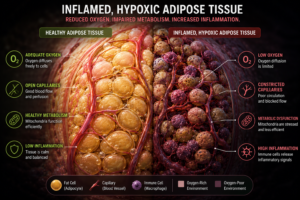
Some fat tissue becomes inflamed, poorly oxygenated, and metabolically sluggish. When this happens, the body cannot efficiently access and use stored energy. This creates a hidden bottleneck that traditional fat loss advice often overlooks.
Not All Fat Behaves the Same
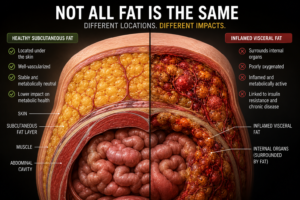
Fat under the skin is relatively stable and less disruptive to metabolism. But fat surrounding organs or building into muscle tissue creates a very different environment.
As these tissues become compressed and inflamed, blood flow begins to decline. Oxygen delivery becomes less efficient. The tissue starts shifting into a stressed metabolic state.
This matters because healthy metabolism depends on oxygen.
Without proper oxygen delivery, cells struggle to produce energy efficiently. Instead of smoothly converting stored fat into usable fuel, the system starts slowing down.
The Problem of Mitochondrial Congestion
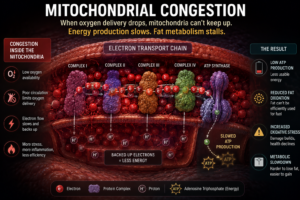
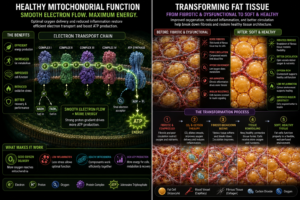
Inside every cell are mitochondria, which help produce energy. They rely on a steady movement of oxygen and electrons to function properly.
But in dysfunctional fat tissue, this process can become congested.
The body may still have fuel available, but energy production begins backing up like a traffic jam. Electrons stop moving efficiently, oxygen is not delivered properly, and the tissue shifts deeper into metabolic stress.
This is one reason why many people feel stuck despite dieting harder or exercising more.
The issue is not always motivation. Sometimes the environment itself is impaired.
Why Oxygen Delivery Changes Everything
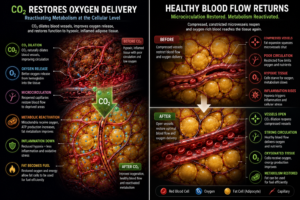
When tissue becomes hypoxic, or oxygen deprived, fat cannot be properly oxidized and used for energy.
This is where carbon dioxide becomes important.
Most people think of CO2 as just a waste gas, but it plays a critical role in oxygen delivery. Carbon dioxide helps oxygen release from the blood into tissues where it is needed most. It also supports circulation at the microscopic level.
As circulation improves, compressed capillaries begin opening again. Oxygen delivery increases. Tissue stress starts decreasing.
The body moves from congestion back toward energy production.
Restoring the Metabolic Environment
As oxygen delivery improves, mitochondria can begin functioning more efficiently again.
Energy starts flowing normally. Inflammation can decrease. Fibrotic tissue, which acts like a rigid scar-like structure around fat cells, may begin softening over time.
This changes the entire metabolic environment.
Instead of forcing the body to burn fat through stress and restriction, the focus becomes restoring healthy tissue function first. When the environment improves, fat metabolism becomes more responsive naturally.
Conclusion
Fat loss is often treated as a simple math equation, but human metabolism is far more complex than calories alone.
Oxygen delivery, circulation, inflammation, and mitochondrial function all influence how efficiently the body can use stored energy. When these systems become disrupted, fat loss can feel nearly impossible no matter how much effort someone puts in.
Restoring the health of the tissue itself may be one of the missing pieces.
Instead of fighting the body harder, the better strategy may be improving the environment so the body can function the way it was designed to.
Learn more at THECARBONATEDBODY.COM