Why More Energy Is Not Solving Modern Fatigue
Modern health culture is obsessed with increasing energy.
People are taking stimulants, supplements, red light therapy, wearable devices, and endless biohacks trying to force more energy into the body. Yet despite all of this stimulation, fatigue, brain fog, burnout, and chronic exhaustion continue to rise.
That raises an important question.
What if the real problem is not a lack of energy at all?
The Body Does Not Just Need Energy
A common mistake in modern health discussions is assuming the body works like a dead battery that simply needs more power.
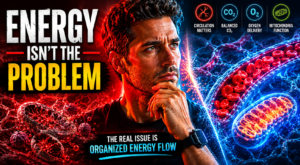
But the body is not just producing energy in isolation. It depends on organization.
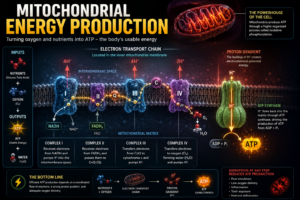
Mitochondria, the structures responsible for producing ATP, rely on stable oxygen delivery, blood flow, carbon dioxide balance, membrane gradients, and coordinated cellular signaling. If those systems become disorganized, adding more stimulation may only create temporary effects.
This is why many people feel briefly better after stimulants or therapies, but still remain chronically exhausted underneath.
Red Light Therapy and Mitochondrial Function
Red light therapy has become increasingly popular because there is legitimate research showing it can influence mitochondrial signaling.
One of the main theories involves a mitochondrial enzyme called cytochrome c oxidase, which helps transfer electrons to oxygen during energy production. Certain wavelengths of red or near infrared light may temporarily influence how efficiently this system functions.
This may slightly improve ATP production, circulation, inflammatory signaling, or cellular stress responses in some situations.
But there is an important distinction most people miss.
Temporary stimulation is not the same thing as restoring healthy physiology.
[INSERT IMAGE: “Mitochondrial Energy Production” infographic]
Why Physiological Terrain Matters
The body operates as an interconnected system.
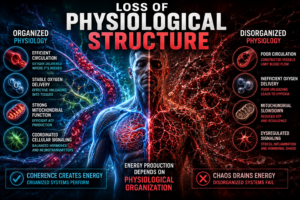
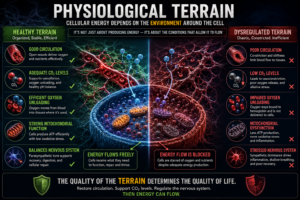
If circulation is impaired, oxygen delivery is unstable, stress physiology is dominant, and the body is chronically over-breathing, then the limiting factor may not be energy production itself.
The limiting factor may be the terrain surrounding the cell.
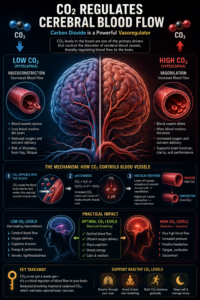
Low carbon dioxide levels can contribute to constricted blood vessels, unstable oxygen unloading, and poor circulation. In that environment, the body becomes less organized and less efficient.
This may explain why some people feel temporary benefits from external stimulation while the deeper dysfunction remains unresolved.
The Problem With the Internet Narrative
Online discussions often exaggerate what red light therapy is actually doing physiologically.
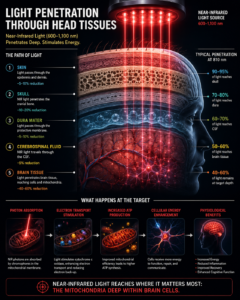
Some people talk as if shining a laser on the forehead deeply energizes the brain or massively restores mitochondrial function. But biological tissue absorbs and scatters light heavily.
Even near infrared light has penetration limitations.
Most effects are likely modest, localized, and signaling-based rather than dramatic system-wide transformations.
That does not mean red light therapy is useless. It may absolutely help recovery, circulation, inflammation, and certain aspects of cellular signaling.
But it does not bypass physiology.
Organization Matters More Than Stimulation
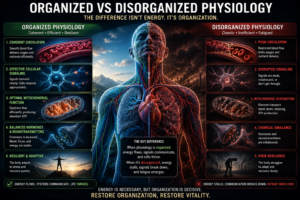
The deeper issue is that energy alone is not enough.
The body requires organized energy flow.
Mitochondria depend on oxygen delivery, vascular regulation, respiratory chemistry, carbon dioxide balance, and stable physiological conditions. When those systems become chaotic, simply adding more stimulation may not solve the underlying problem.
This is where carbon dioxide becomes especially important physiologically. CO2 helps regulate blood flow, oxygen unloading into tissues, vascular tone, and nervous system state.
Instead of asking how to force more energy into the body, we may need to ask a different question:
Why can energy no longer flow properly?
Conclusion
Modern fatigue may not simply be an energy deficiency.
It may be a problem of disorganized physiology.
A healthy system does not merely produce energy. It distributes energy coherently through stable circulation, oxygen delivery, respiratory chemistry, and coordinated cellular signaling.
Red light therapy may have useful applications, but lasting health likely depends on restoring the structure that allows energy to move efficiently throughout the body in the first place.
Learn more at THECARBONATEDBODY.COM