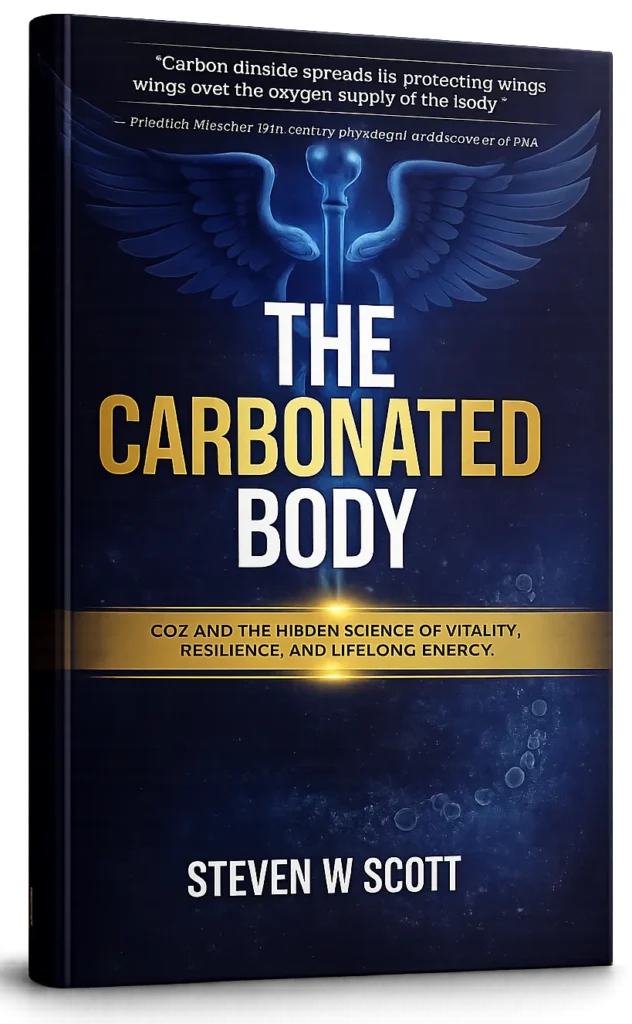
Oxygen carried in the blood is not the same as oxygen delivered to the cell. Between those two facts lies almost everything we misunderstand about fatigue.
Introduction: The Wrong Question
Millions of people wake up exhausted. They sleep eight hours. They eat well. They exercise. They take the supplements. And still, somewhere around midmorning, the weight comes back.
The standard explanation is simple: your body is not making enough energy. Take more iron. Boost your mitochondria. Increase your ATP production. The assumption buried in all of it is that fatigue is a manufacturing problem, that somewhere in your cells the factory has slowed down and needs to be restarted.
That assumption is worth questioning.
Your mitochondria, in most cases, are not broken. They are waiting. They are waiting for the oxygen and nutrients that have to be delivered to them before any energy can be produced at all. The factory may be fully functional. What is failing is the supply chain.
This distinction changes everything about how we understand chronic fatigue, and it changes the questions worth asking.
1. The Seven-Step Delivery System
The body does not run on energy alone. It runs on a chain of events, each step dependent on the one before it. Break any link and the whole system suffers, even if every other link is intact.
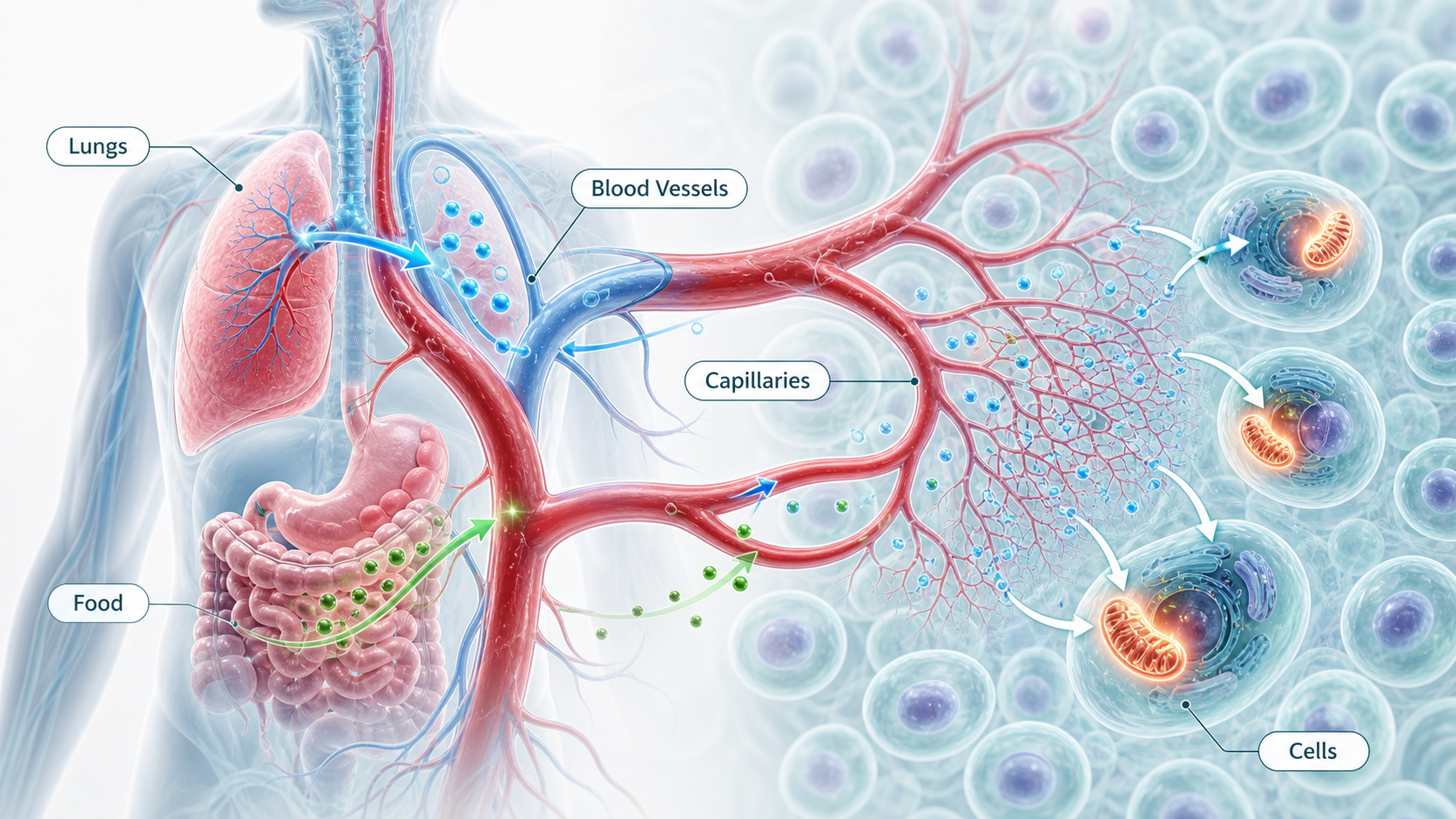
Here is the sequence your body runs through, continuously, every moment you are alive:
- Food provides raw materials. Glucose, fatty acids, and amino acids enter the bloodstream from the digestive system.
- Oxygen enters through the lungs. With each breath, oxygen crosses the alveolar membrane and binds to hemoglobin in the red blood cells.
- The heart pumps blood outward. Oxygenated blood moves from the lungs through the heart and into the arterial network.
- Arteries branch into arterioles. Blood pressure and vascular tone direct flow toward tissues that need it most.
- Arterioles feed the capillaries. The finest vessels in the body, often just wide enough for a single red blood cell to pass through, bring the blood into contact with individual tissues.
- Exchange happens across the capillary wall. Oxygen and nutrients cross from the blood into the surrounding cells. Waste products, including carbon dioxide, cross back the other way.
- Mitochondria convert the delivered materials into ATP. Only here, at this final step, does the energy your body actually uses get made.
Seven steps. The conversation about fatigue almost always begins at step seven. It almost never addresses steps four, five, and six, which is precisely where the breakdown most often occurs.
Structure provides the channels. Flow delivers what moves through them. And the terrain of the tissue determines whether what arrives can actually be used. Fatigue rooted in delivery failure is not a mitochondrial problem. It is a problem of structure, terrain, and flow, the three invisible architectures upon which all of life rests.
2. The Critical Handoff: Where Energy Goes Missing
The most important moment in this entire sequence is not the moment oxygen enters your lungs. It is the moment oxygen leaves the blood and enters the cell.
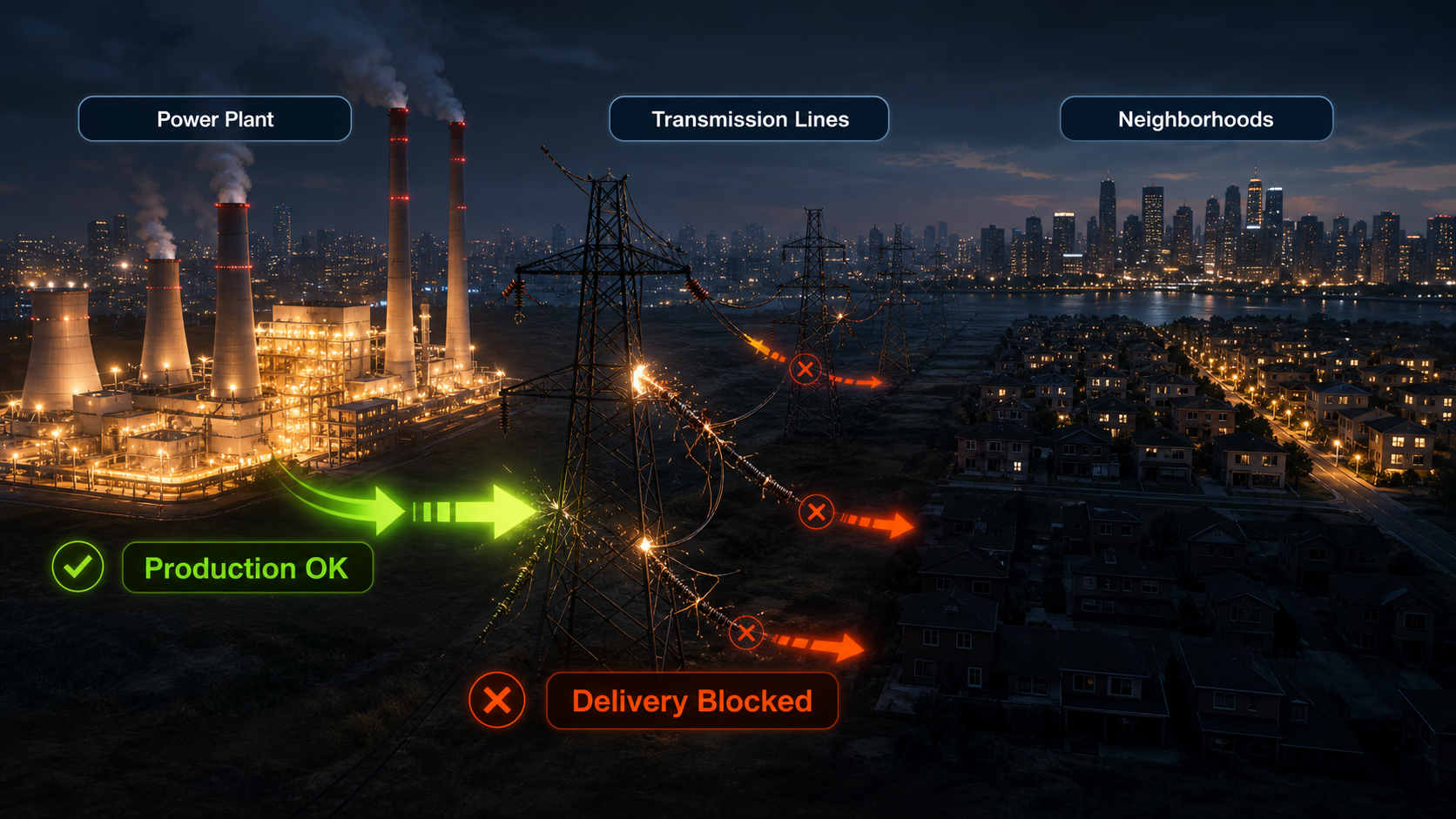
Having oxygen in circulation is not the same as having oxygen available to the tissue. A city can have power running through its grid without a single light turning on inside a building. The problem is not generation. It is delivery.
At the level of the capillary, several things must happen simultaneously for this handoff to work. The blood must reach the capillary bed in the first place, which depends on adequate flow and open microvascular channels. The capillary walls must be permeable enough to allow exchange. And hemoglobin, the protein carrying oxygen inside the red blood cell, must actually release it.
That last condition is where most people never think to look.
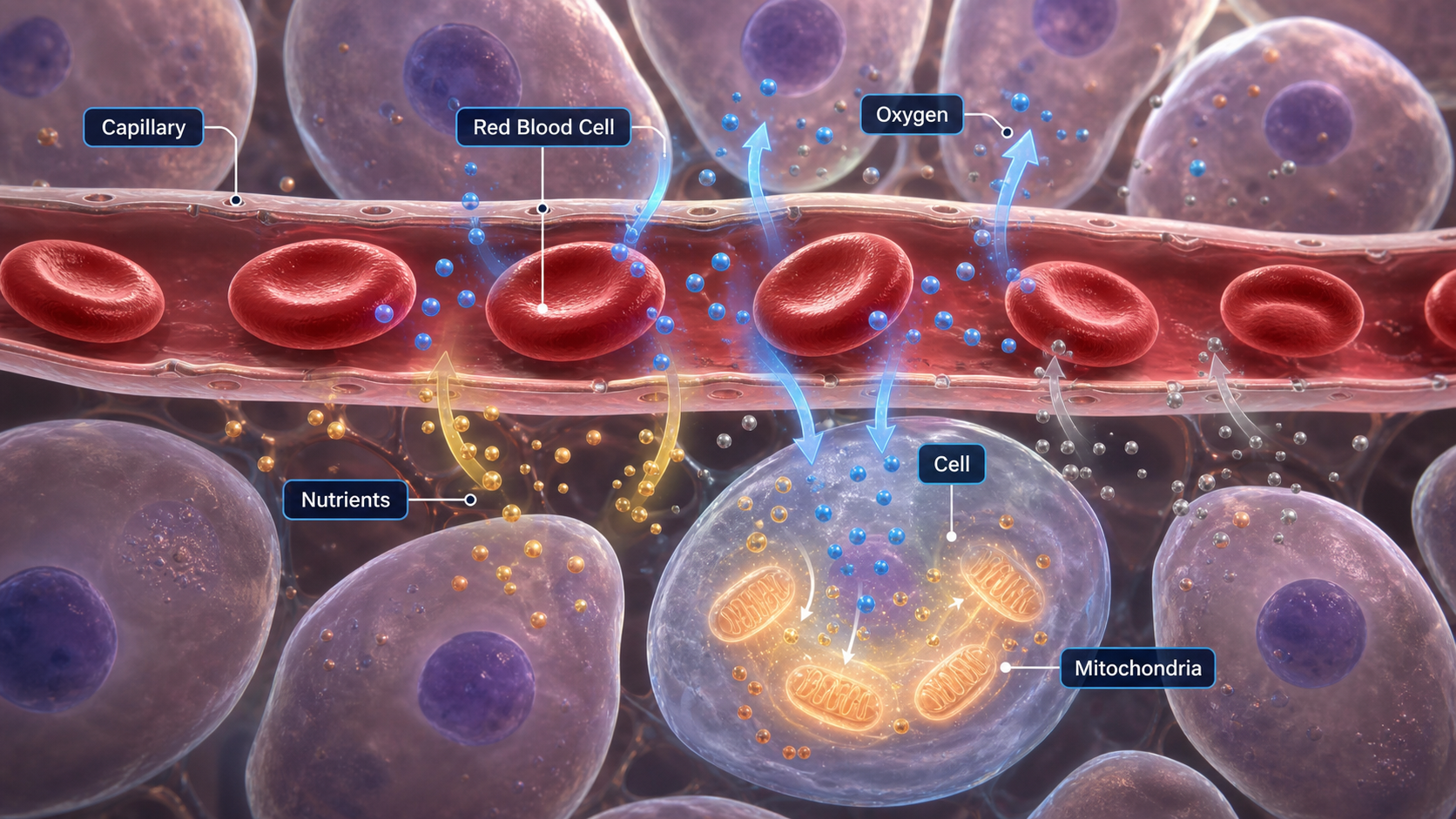
Hemoglobin does not release oxygen automatically. It releases oxygen in response to specific chemical signals from the surrounding tissue. When those signals are absent or weak, hemoglobin holds on. The oxygen circulates. It returns to the lungs still bound. The tissue, meanwhile, remains underserved.
You can have a perfect oxygen saturation reading on a pulse oximeter and still have chronically under-oxygenated tissue. The presence of oxygen in the blood tells you nothing about whether that oxygen is reaching the cells that need it.
3. The Bohr Effect: A Discovery That Changed Everything
In 1904, Danish physiologist Christian Bohr made an observation that quietly reframed the entire science of respiration. He found that hemoglobin’s grip on oxygen was not fixed. It varied depending on the chemical environment of the blood, specifically its carbon dioxide concentration and acidity.
The more carbon dioxide present in a tissue, and the more acidic the local environment, the more readily hemoglobin released its oxygen. The less carbon dioxide present, the more tightly hemoglobin held on.
This became known as the Bohr Effect.
The implication is profound. Active tissue produces carbon dioxide as a natural byproduct of metabolism. That carbon dioxide, accumulating locally, acts as a chemical signal to the hemoglobin passing through. It communicates: release oxygen here. This tissue is working. This tissue needs fuel.
Carbon dioxide is not announcing inefficiency. It is announcing activity. And hemoglobin, reading that signal, responds by loosening its grip and letting oxygen go where it is needed.
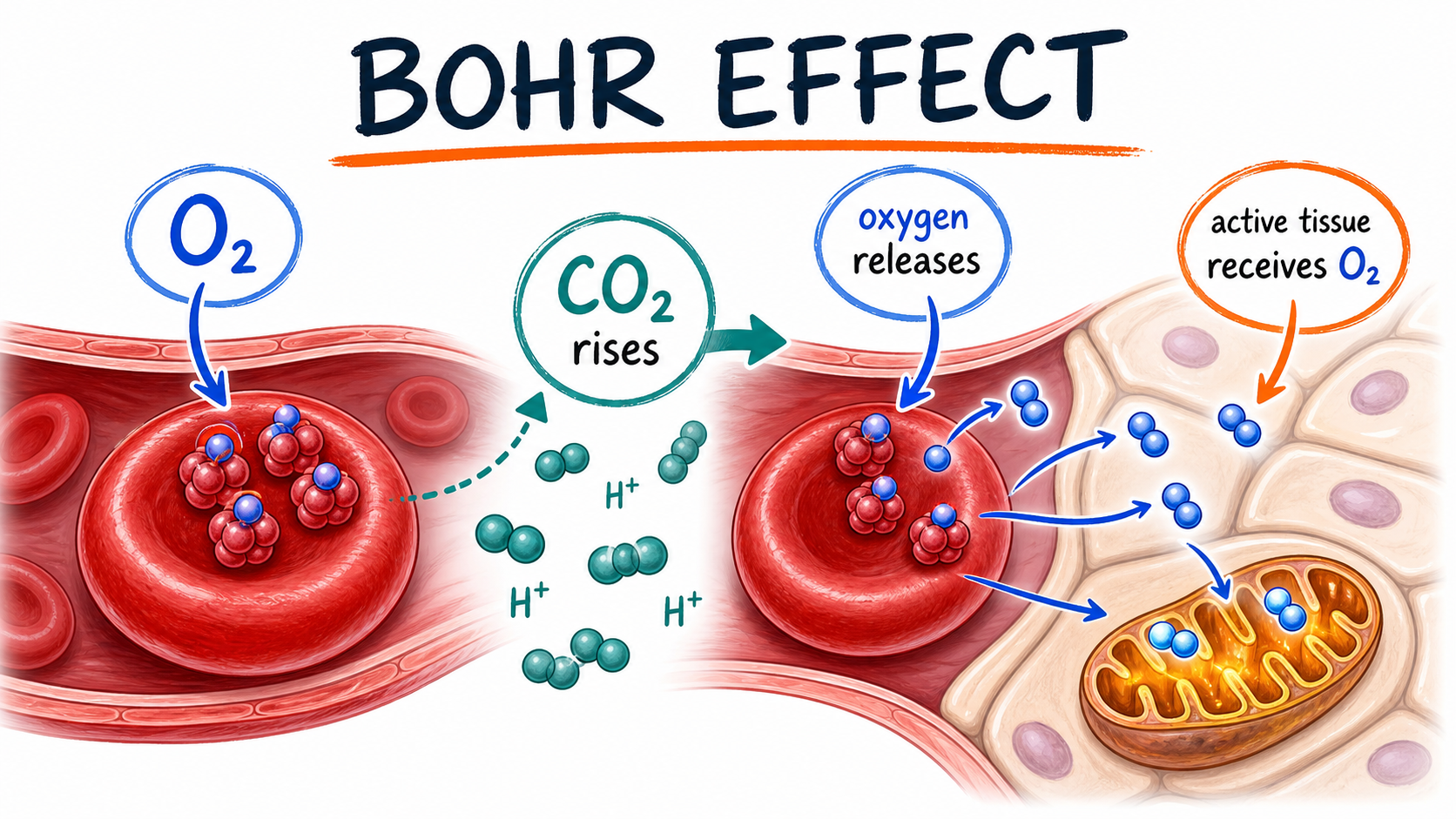
The key and the lock. Carbon dioxide is the key that opens hemoglobin’s hold. Without it, the oxygen stays bound. The lock stays closed. And the tissue, regardless of how saturated the blood is, waits.
This is not a flaw in the system. It is the system. It is the mechanism by which your body ensures that oxygen reaches the right place at the right time in the right amount. The Bohr Effect is not a curiosity in a textbook. It is one of the primary regulators of whether your cells can actually function.
4. Carbon Dioxide as the Delivery Signal
Carbon dioxide is almost universally misunderstood. It is taught as a waste product, the thing you exhale and forget. But that framing is incomplete in a way that matters enormously.
Carbon dioxide does not merely wait to be exhaled. Before it leaves the body, it does significant work. It participates in the Bohr Effect, signaling hemoglobin to release oxygen. It influences vascular tone, helping to dilate blood vessels in areas of high metabolic activity so more blood can reach those tissues. It participates in regulating blood pH, which affects enzymatic function throughout the body.
CO2 does not push the current. It opens the path.
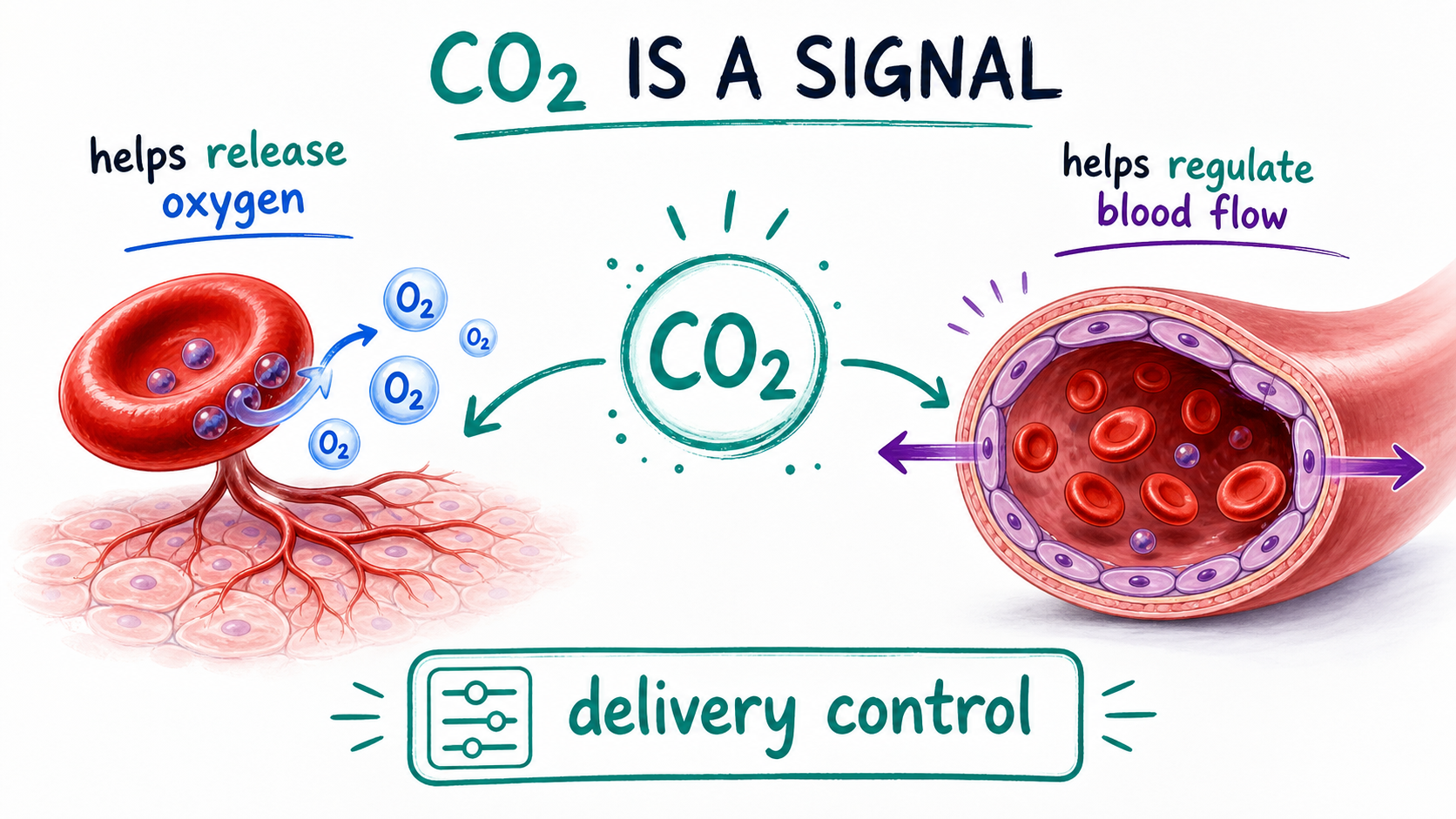
In terms of the terrain, structure, and flow framework, carbon dioxide operates at all three levels simultaneously. It maintains the terrain by supporting the chemical conditions that allow cellular work to proceed. It preserves structure by influencing the tone and caliber of vessels. And it governs flow by directing oxygenated blood toward the tissues that have earned it through their own metabolic activity.
No single molecule coordinates these three systems at once. Carbon dioxide does.
When carbon dioxide levels are chronically disrupted, whether through overbreathing, poor circulation, or compromised metabolic function, the entire delivery chain suffers. Oxygen remains in the blood. Vessels fail to dilate appropriately. Tissue operates in a state of functional oxygen deprivation even when the lungs are working and the heart is beating.
5. When the System Breaks Down
Chronic fatigue, the kind that persists despite adequate sleep and reasonable health habits, often traces back to one or more failures in this delivery chain rather than to mitochondrial dysfunction itself.
Consider what compromised delivery looks like at each level:
Reduced microcirculation. When capillary beds are partially collapsed or underperfused, large regions of tissue receive diminished blood flow. The cells in those regions produce less CO2 signal, which means less oxygen release, which means less energy production, even though the blood supply upstream is adequate.
Overbreathing. Chronic hyperventilation lowers blood CO2 below the level needed to trigger effective oxygen release via the Bohr Effect. Paradoxically, breathing more can mean delivering less oxygen to the tissue. The blood arrives saturated. The oxygen stays bound.
Vascular rigidity. Vessels that have lost their ability to dilate in response to local metabolic signals cannot redirect blood where it is needed. Flow becomes fixed rather than adaptive. Active tissues compete poorly for resources they should receive automatically.
Compromised capillary exchange. Inflammation, glycation, or structural changes in the capillary walls can impair the exchange of oxygen and nutrients even when blood flow is present. The delivery truck arrives. The loading dock is closed.
In each case, the mitochondria are not the problem. They are the last stop on a broken supply line.
Conclusion: The Question Worth Asking
Disease does not emerge in well-perfused, well-oxygenated, dynamically remodeling tissue. Fatigue does not persist in a body where the delivery system is working.
The question most people ask when they are tired is: how do I make more energy? It is a reasonable question. But it starts at step seven of a seven-step process and ignores the six steps that determine whether step seven is even possible.
The more useful question is: how does energy actually reach my cells?
Follow that question and you arrive at terrain, the internal conditions of the tissue. You arrive at structure, the architecture of vessels and capillary beds that channels the flow. You arrive at flow itself, the delivery mechanism that connects oxygen in the blood with oxygen in the cell.
And you arrive at carbon dioxide, not as a waste product to be eliminated as quickly as possible, but as the coordinator of the entire system. The molecule that reads the terrain, signals the structure, and governs the flow.
The Bohr Effect is not an isolated biochemical footnote. It is one expression of a larger principle: that the body is not a collection of independent parts. It is a system of systems. And when you ask why you are always tired, the answer is rarely at the end of the chain. It is somewhere in the middle, in the invisible architecture of delivery that most medicine never thinks to examine.
For the complete whiteboard lesson with full visual walkthrough, watch the video above or visit CO2VIDEOS.com. To learn more about the terrain, structure, and flow framework, visit Carbogenetics.com.
Medical Disclaimer: This article is for educational purposes only and does not constitute medical advice. Always consult a qualified healthcare professional regarding any medical condition or treatment decision.