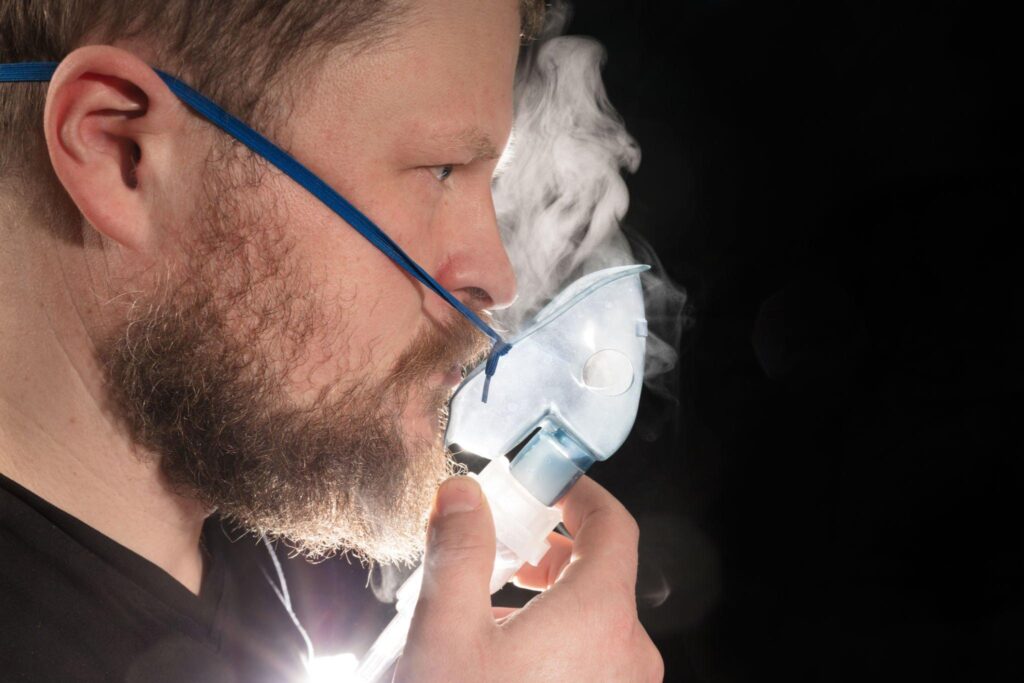
INHALATIONAL TREATMENT OF ANGINA PECTORIS AND INTERMITTENT CLAUDICAT1ON” YANDELL HENDERSON, PH.D. NEW HAVEN, CONN. INHALATION of carbon oxide is now administered for various thera- peutic and prophylactic purposes. The benefits afforded depend chiefly on the part which carbon dioxide plays in the control of respi- ration. Resuscitation from asphyxia of the newborn,1 prevention of postoperative atelectasis and pneumonia,2 elimination of ethyl ether,2 of carbon monoxide,4 and of other anesthetic and toxic gases3 from the lungs and blood, all alike depend upon the increase of pulmonary ventilation under stimulation of the respiratory center by inhalation of carbon dioxide. INFLUENCE OF CARBON DIOXIDE UPON TIIE HEART AND BLOOD VESSELS The equally marked influence of carbon dioxide upon the circulation has not as yet, or to an equal degree, been exploited for therapeutic purposes. Yet, simultaneously with the modern development of res- piration, physiology has produced also observations indicating a pow- erful influence of carbon dioxide upon the heart. In a long series of experiments,6 from fifteen to twenty-five years ago, my collaborators and I demonstrated on dogs, under artificial respiration or breathing naturally under a slight pressure of air after the opening of the tho- rax, a condition verging on tetanus of the heart-in the physiological sense of the word tetanus, that, is a fusion of successive beats. This state was effectively counteracted and heartbeats of full amplitude were restored as a consequence of the restoration of a normal,or per- haps slightly excessive, carbon dioxide content in the blood. The les- son of these observations is now generally applied in experiments upon the isolated heart in the Starling7 heart-lung preparation. It is rec- ognized that the blood for perfusion, in addition to being oxygenated, must also be supplied with a sufficient amount of carbon dioxide to overcome the tendency of an exposed or excised heart to develop an inadequate diastolic relaxation. Otherwise it passes into a continuous systolic state, an incomplete tetanus or cramp of the heart. Following these observations upon the heart, it was shown in an- other series of experiments” that carbon dioxide may exert an equally strong influence upon the peripheral circulation, and particularly upon the volume of the venous return to the right heart. Clinically this *From the Laboratory of Applied Physiology, Sheffield Scientific School, Yale University, effect is best seen as a result of the inhalation of carbon dioxide after a prolonged and extensive surgical operation under open ether anes- thesia. The return of blood to the cutaneous vessels, the flushing of the skin, the refilling of the veins previously collapsed, bear at least a superficial similarity to the effects induced by inhalation of amyl nitrite. But the effects, like those of a hot bath and in contrast to amyl nitrite, are more physiological than pharmacological; they are lasting and are accompanied by a restoration of a full strong heart action and a recovery of normal arterial pressure. Never in my expe- rience have there been any symptoms suggesting an overloading of the heart. Among the various treatments of heart disease, that at Nauheim is the most celebrated. It consists in baths in carbonated water. The good effects, which the treatment, is claimed to have, have never really been explained. There is a stimulating action upon the skin, but there is little ground for believing that a slight cutaneous hyperemia can by itself be of much benefit. It is at least possible that the greater part of the benefit sometimes derived from the Nauheim treatment is due rather to inhalation of the carbon dioxide volatilizing from the surface of the bath. DECREASE OF ANGINA UNDER INHALATION With these considerations as a physiological background, it has seemed to me justifiable to try, with all due caution at first, the influ- ence of carbon dioxide inhalation upon cases of angina pectoris which are as yet in their earlier stages, but in which moderately severe suf- fering on exertion is already developing. This is not an emergency treatment, but a therapy for prolonged application. The inhalations are not given during an attack of pain, but at regular times every day, usually before the midday and evening meals, and at bedtime. The patient lies quietly on his back for a few minutes holding over his own face a mask which has a sufficiently large opening to the outside air to offer no resistance to breathing. He is told to keep his mouth open and to breathe deeply rather than rapidly. Then a stream of carbon dioxide gas through a small rubber tube from a cylinder of the pure liquefied substance is fed to the mask. At first the flow is kept small, but as respiration gradually deepens the amount of the gas is increased until at the end of two or three minutes a maximal or nearly maximal depth of breathing is developed. The stimulation is not, however, pushed to the point of increase of rate. This condition is maintained for fifteen or twenty minutes continuously. Then the gas is shut off, and the patient is directed to lie quiet for ten minutes more, so as to avoid the slight giddiness which occurs if he gets up immedi- ately. THE AMERICAN HEART JOURNAL It is to be noted that the technic of this inhalation differs markedly from the use of a mixture of oxygen and 7 per cent carbon dioxide. which is best employed for resuscitation from asphyxia. The inhala- tion used on these heart eases is on the contrary essentially like that applied by Henderson, Haggard and Coburn, and by White after anes- thesia and operation.3 A mixture of oxygen and carbon dioxide is rather expensive, and a cylinder of it, is exhausted in a single inhala- tion; while on the contrary even a small cylinder of liquid carbon dioxide lasts for several weeks of this treatment.. so that its cost, aside from the control apparatus, is slight. But of course pure carbon dioxide should be used only with such an open mask that the small volume